Posts

Showing posts with the label Zirconia Ceramic parts

High Zirconia Ceramic Refractory Parts for Glass Furnaces

Image
  Longer furnace life directly translates to lower glass manufacturing costs. Although fused-cast high-zirconia is considered one of the best materials for glass furnaces, its long delivery time and high price have hindered large-scale adoption. Furthermore, poor thermal shock resistance and industry-wide quality control issues have led to significant variations in performance and application outcomes.     A new series of large-size, 5.0 g/cm³ density fused high-zirconia bricks (free from silicon and sodium impurities) effectively addresses common challenges in glass furnace refractory applications. These bricks can withstand long-term operating temperatures up to 2000  ° C and provide remarkable performance in environments containing sodium, boron, lead, fluorine, and other glass components, as well as in areas requiring high electrical resistivity.     Under operating conditions above 1550  ° C, their lifespan is more than three times that of convent...
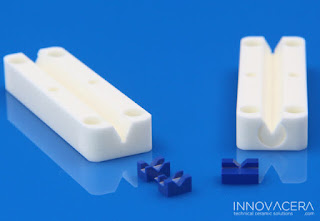
Zirconia Ceramic V Groove Parts For Optical Fiber Fusion Splicer

Image
The  Zirconia Ceramic V-Groove  is an important part of the optical fiber fusion splicer. Its function is to fix and support the left and right optical fibers in the fusion splicing process. It is used in ribbon optical fiber fusion splicer for fusing ribbon optical fiber, leather wire fusion splicer for fusing covered cables and jumpers, and polarization maintaining optical fiber fusion splicing machine for fusing polarization maintaining optical fiber, etc. Zirconia ceramic  is commonly used in optical fiber fusion splicers for several reasons: Low thermal expansion:  Zirconia ceramic has a low coefficient of thermal expansion, which means it doesn’t expand significantly when exposed to high temperatures. This property ensures that the splicer maintains a stable structure during the fusion process. Chemical resistance:  Zirconia ceramic is highly resistant to chemicals, including acids and alkalis. This resistance ensures that the ceramic components remain int...

Zirconia Ceramic Ring

Image
The lattice of  zirconia ceramics   is stable at high temperatures, and the lattice phase is damaged once it reaches normal temperatures. Therefore, 94.8% of zirconia reaches a stable state at room temperature, and a 5.2% stabilizer must be added. The powder is dry-pressed and sintered at 1560 ℃, the hardness and toughness will exceed 99% alumina ceramics, and its wear resistance and impact resistance will exceed 99% alumina ceramics. If no stabilizer is added, the ceramic is easy to crack, so zirconia balls are used as abrasive materials because they have great hardness and toughness.