The manufacturing process of high thermal conductivity ceramic substrates
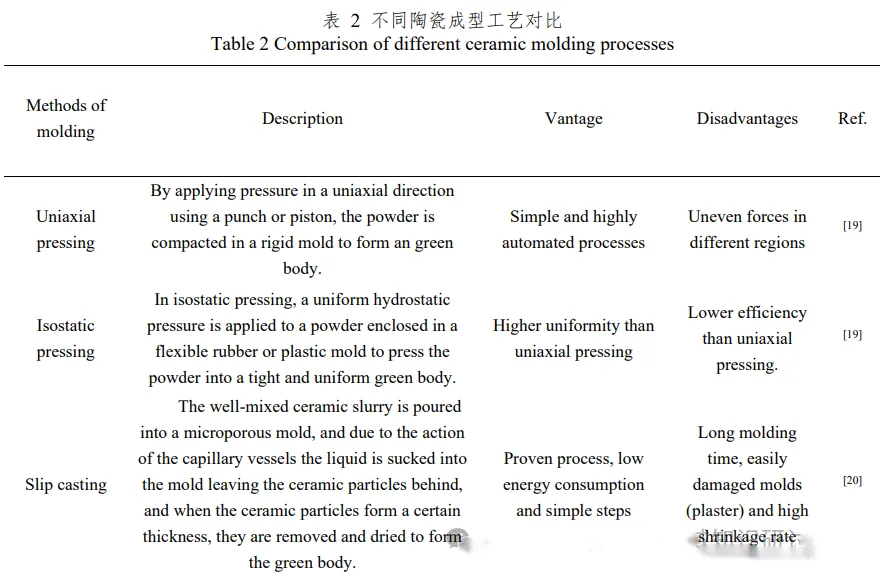
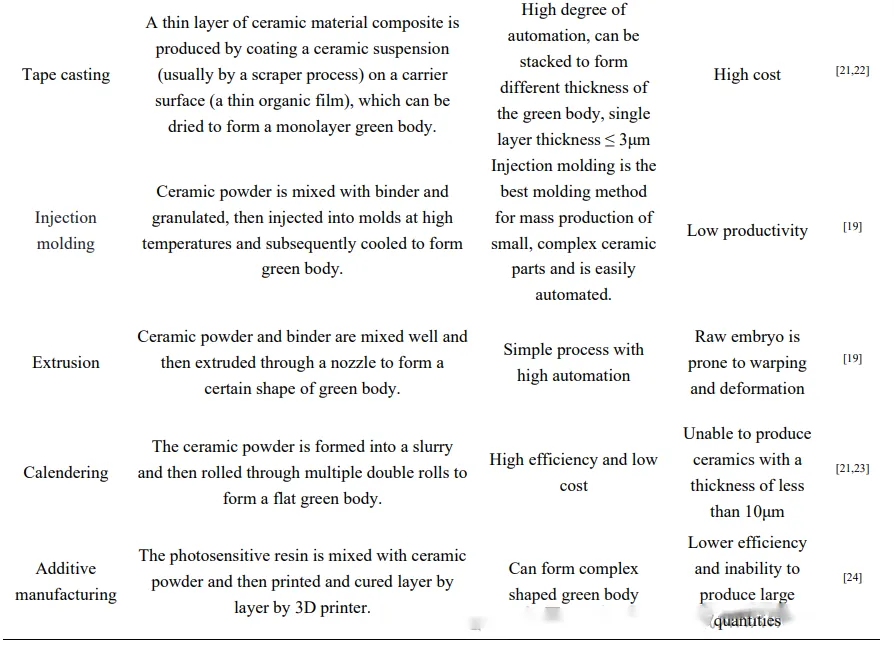
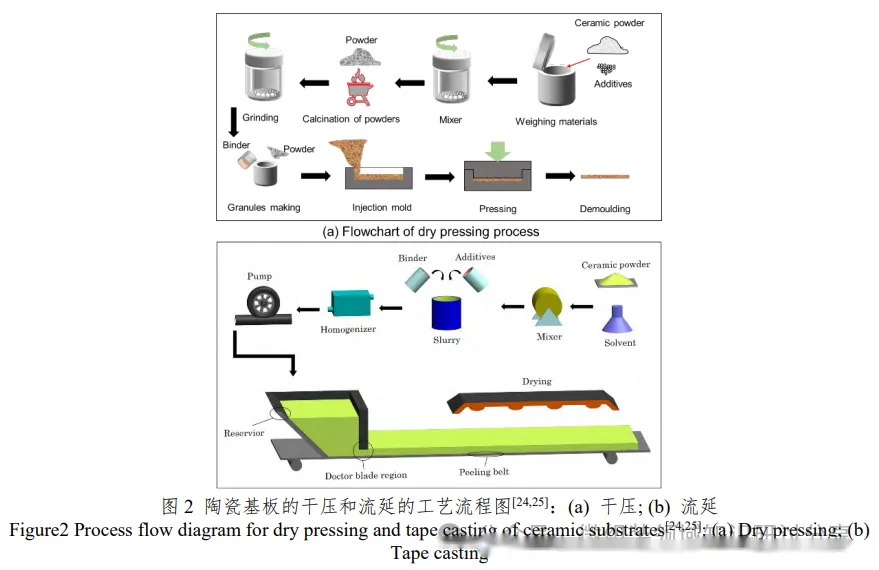
The ceramic substrates used for high-power devices are mostly planar. The manufacturing process of planar ceramic substrates can be divided into two steps: forming and sintering. The common forming processes and their characteristics in the reports are shown in Table 2. Among them, dry pressing and tape casting are widely used in the industrial production of ceramic substrates. The process flow of dry pressing is shown in Figure 2a, and the pressure application and holding time are the most important parameters in the dry pressing process. Tape casting is considered to be an economical, continuous and automated process for manufacturing large-sized planar ceramic substrates, and its process is shown in Figure 2b. Tape casting has the characteristics of low cost and high efficiency in preparing multi-layer materials and devices, and is widely used in the manufacture of such items as low-temperature co-fired ceramic substrates, capacitors and microwave dielectric ceramic devices.
The sintering of ceramics is the process of forming dense ceramic blocks from ceramic powders at high temperatures. High thermal conductivity materials such as SiC, AlN, and Si3N4 are difficult to be sintered into dense ceramic blocks using pure ceramic powders due to their particularly strong covalent bonds. Usually, by adding low-melting-point additives and mixing for molding and then sintering together, the density of the sintered body can be increased. Sintering is classified into solid-phase sintering and liquid-phase sintering based on whether a liquid phase is formed during the sintering process. Both processes are driven by the reduction of total surface energy. Solid-phase sintering is a ceramic densification method that does not require the participation of a liquid phase. This process mainly achieves through three mechanisms: vapor transport, surface-atom-lattice-grain boundary diffusion, and plastic deformation driven by dislocation migration. These mechanisms jointly promote effective dense connections between ceramic particles within the ceramic. Liquid-phase sintering is a sintering process where additives transform into a liquid state at high temperatures, forming a system where solid particles and liquid phase are in chemical equilibrium. And as the sintering progresses, the growth and densification of ceramic grains occur simultaneously. If classified by the process, sintering processes can also be divided into pressureless sintering (PLS), gas pressure sintering (GPS), hot press sintering (HPS), hot isostatic pressure sintering (HIPS), and spark plasma sintering (SPS). Among them, SPS, HPS, and HIPS are not suitable for large-scale production of ceramic substrates due to high requirements for conditions or complex processes.
Conclusion
The manufacturing process of ceramic substrates is relatively simple, but there are higher requirements for process control and product stability. Different manufacturers have different control standards, so it is necessary to choose based on customer needs.For more information, pls contact with us sales@innovacera.com


Comments
Post a Comment